New to board racing? Start here
Models · Fin codes · Owner manual
Boards
The 6 models on the cover of the manufacturer's manual, with type codes and fin part numbers. 2 are named in a closed class's board list; the open classes name none. Stated top speeds run from 55 to 64 km/h (35 to 40 mph).
Why fin part numbers matter in MotoSurf racing
FCS is the required fin system in 6 of the 8 classes, and in the 3 of those with a sealed engine fins are among the few things a rider may change. The 6 models run 5 fin part numbers.
| Model | Type | Weight, without bindings | Top speed, as stated | Side fin code | Centre fin code | Class lists |
|---|---|---|---|---|---|---|
| JetSurf Race DFI SL | JR-H1 | 19.5 kg | 58 km/h (36 mph) | R06Z083 | R06Z082 | Named in a closed class Admitted by Elite Women, Masters Women, Juniors Boys and Juniors Girls. |
| JetSurf Race DFI SKI | JR-G1 | 24.9 kg | 58 km/h (36 mph) | R06Z083 | R06Z082 | Not named in any closed class |
| JetSurf Titanium DFI SL note 1 | JT-E1 | 18.5 kg | 64 km/h (40 mph) | R06Z085 | P004463 | Named in a closed class Admitted by Stock Men. |
| JetSurf Titanium DFI SKI | JT-F1 | 24.9 kg | 62 km/h (39 mph) | R06Z085 | P004463 | Not named in any closed class |
| JetSurf Cruiser DFI note 2 | JA-E1, JA-F1 | 20.5 kg | 55 km/h (35 mph) | R06Z083 | R06Z082 | Not named in any closed class |
| JetSurf Adventure DFI note 3 | JA-E1, JA-F1 | 20 kg | 55 km/h (35 mph) | R06Z081 | R06Z082 | Not named in any closed class |
| JetSurf Adventure DFI Plus note 4 | None on the cover | 18.5 kg | 55 km/h (35 mph) | Not given | Not given | Not named in any closed class |
- JetSurf Titanium DFI SL: The rulebook bars it by name from four classes: Elite Women and Masters Women at Art. 503.01 c), and both Juniors classes at Art. 504.01 c). That is a stronger statement than a class that simply does not list it.
- JetSurf Cruiser DFI: Not named in any class in either rulebook. The manual gives this model and the Adventure DFI identical type codes and does not explain why.
- JetSurf Adventure DFI: Neither rulebook names it in any class. Its side fin is the one model in the range named as FCS rather than FCS II, and a seventh name, Adventure DFI Plus, appears in the manual's technical tables but not on its cover.
- JetSurf Adventure DFI Plus: Named only in the manual's technical table. The model list on the manual's cover leaves it out, and no type code or equipment list is given for it.
Model names and type codes as the manual's cover prints them, and fin part numbers as its equipment tables print them.
No class in either rulebook names a SKI variant (Race DFI SKI, Titanium DFI SKI). Art. 311.01 bars riding lying down or kneeling, which points against them without settling eligibility, and no article addresses them, so both are recorded as named by no class.
Where the equipment tables break their own pattern
One side fin is named FCS, not FCS II (Adventure DFI). The manual does not say whether that is a different system or loose typing, and the rulebook does not address fin systems at that level of detail either, so the name is printed as given.
The centre fin on JetSurf Titanium DFI SL and JetSurf Titanium DFI SKI is a different part with a different name. Their equipment list gives Center fin L200, described with no flange, where the other 4 models take FCS II Connect GF 7" - Center fin. A centre fin bought against the wrong one of those two names is the wrong part, and the manual does not warn anybody about it.
Every fin code, and what it fits
One row per fin part number: the boards it ships on, and which class rule reaches that position.
Read the last column as where a rule applies, never as which part it names. The classes that require a fin system do not word the requirement alike. Stock Men asks for FCS side fins that work with approved adjusters (Art. 502.04 d)). Elite Women, Masters Women and both Juniors classes take any officially certified FCS fin that works with the provided adjustors (Art. 503.05 d) and 504.05 d)). Electric Challenge asks only for officially certified FCS fins and says nothing about adjusters (Art. 505.04 d), in the article headed Fins requirements). No document held here says which parts are certified or which adjusters they fit. So a class in that column means the rule covers that position on that board. It does not mean this code satisfies it, and nothing on this site will tell you that it does.
| Code | Fin, as the manual names it | Fitted | Boards | Where a side fin rule applies |
|---|---|---|---|---|
| R06Z083 | FCS II Performer Black Medium - Side fin | side | JetSurf Race DFI SL, JetSurf Race DFI SKI, JetSurf Cruiser DFI | Elite Women, Masters Women, Juniors Boys and Juniors Girls |
| R06Z082 | FCS II Connect GF 7" - Center fin | centre | JetSurf Race DFI SL, JetSurf Race DFI SKI, JetSurf Cruiser DFI, JetSurf Adventure DFI | No rule reaches it |
| R06Z085 | FCS II Power Twin JS PG Retail Fins | side | JetSurf Titanium DFI SL, JetSurf Titanium DFI SKI | Stock Men |
| P004463 | Center fin L200 | centre | JetSurf Titanium DFI SL, JetSurf Titanium DFI SKI | No rule reaches it |
| R06Z081 | FCS Accelerator Large Neo Glass - Side fin | side | JetSurf Adventure DFI | No rule reaches it |
Not every name in that table begins FCS. These do not: Center fin L200 (P004463). Every fin rule in either edition names FCS and names nothing else, and Stock Men admits a board that leaves the factory carrying one. The rule that reaches that board is written for side fins, so the rulebook does not address this part at all. Take that as a silence rather than as a permission. These articles run a closed list everywhere else, and a rider who reads an unaddressed part as a free choice is reading the one thing the rest of the document says it is not.
- Solid lines carry the throttle cable's pull, fuel, exhaust gas, the turning drive, water or electric current. The dotted lines are control links: the control unit's hold over the engine, and the shut-off key's place in the throttle controller.
- Throttle controller (the manual's control handle) to engine: the lever sits at the end of a cable that opens and closes the injector flap on the engine (JetSurf owner manual, 5.1 and 8.16).
- Control unit to engine: after five minutes idle, the ignition control unit switches the electronics off and shuts the board down (JetSurf owner manual, 5.8). Shut-off key: worn on the rider's wrist, it sits in the ignition switch socket on the control handle, and pulled out in a fall it shuts the engine off (JetSurf owner manual, 5.1). Fuel tank to engine: a fuel hose and pump, coupled to the injector (JetSurf owner manual, 6.1). Engine to exhaust: it leaves at the stern, into the water (JetSurf owner manual, 3.3).
- Engine to pump: the jet pump drive shaft (8.9 and 10.6); turning that shaft by hand moves the engine's piston (12.5). The JetSurf owner manual also labels a main gear (freewheel) on every model's engine picture (chapter 4) and lists gears among the parts to lubricate (10.6), but does not say where they sit in the drive, so they are not drawn. The pump reference shared by both forms runs to the driveshaft and gives the intake grate hole the water comes in by.
- The stator's fixed blades sit behind the impeller and take out the water's spin, so its energy goes into thrust, as the held jet pump patent US 8,905,800 B2 describes; the water then leaves through the nozzle, which the patent puts at the pump's outlet and the manual's technical table gives a material (chapter 14). Names in both forms: the pumps Jetpump Titan Stock and Jetpump MSR DFi, the stators Stator Titan Stock and Jetpump stator DFi; the impeller and the control unit are shared.
- The second strip is the Electric Challenge class, a fully electric board (Art. 100): 3 labelled battery packs per board for the event, and one more if a pack fails and the scrutineer accepts it (Art. 505.03); a motor, whose RPM every pack must report (505.03 c)); a safety shut-off key, which the power unit must have (505.01 c)); and a pump impeller integrated into the pump tunnel (505.04 i)). The rulebook names the motor and the impeller but does not say that one turns the other, so that line is drawn as an inference from the combustion strip. Art. 505 names no stator and no nozzle, so neither is drawn.
Whatever the model, the board is pushed by a jet of water, and the engine or motor is there to spin the pump that makes it. Not a drawing of any board.
How we know: Part names from the homologation forms in Appendices 2 and 3 of the 2026 MotoSurf Rulebook and from the JetSurf owner manual; each link is read from the document the list above names for it.
Not to scale.
The technical table gives 7 models, one not on the cover, their own weight and top speed; every model shares the figures below. Fuel grade, oil standard and spark plug are on the kit page.
-
JetSurf Race DFI SL
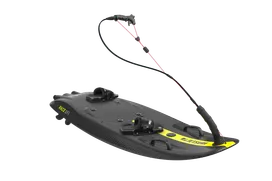
Studio image: JETSURF.
-
JetSurf Race DFI SKI
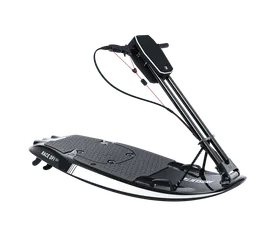
Studio image: JETSURF.
-
JetSurf Titanium DFI SL
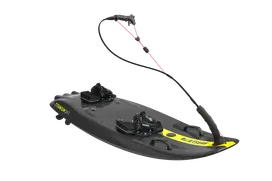
Studio image: JETSURF.
-
JetSurf Titanium DFI SKI
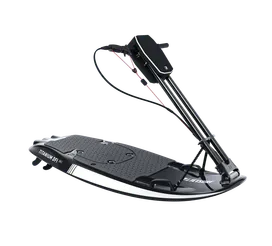
Studio image: JETSURF.
-
JetSurf Cruiser DFI
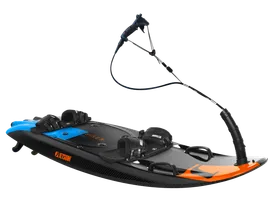
Studio image: JETSURF.
-
JetSurf Adventure DFI
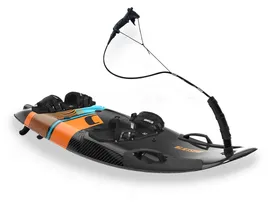
Studio image: JETSURF USA.
6 models carry a studio image from the product pages of JETSURF and JETSURF USA, credited and linked on each. They are studio images that read as renderings, not photographs of a board, and no figure here is read from them. A small credited copy of a studio image as its publisher put it online, linked to the page it came from. It comes down at the publisher's request. The Adventure DFI's picture is from JETSURF USA, the maker's US dealer, because the maker's own site no longer lists a model by that name, only an Adventure 2 DFI, a name the manual's cover and technical table do not use.
The same on every model
- Length
- 1800 mm
- Width
- 600 mm
- Height
- 150 mm
- Maximum load
- 120 kg
- Carries
- One user
- Design category
- D
- Engine
- 100 cc two-stroke horizontal engine, single-cylinder, water cooled
- Fuel
- Digital fuel injection, petrol premixed with oil at 50 : 1
- Control unit
- ICU processor
- Starter
- 3-phase BLDC
- Battery
- Li-Ion 100 Wh (9 Ah), nominal voltage 11.1 V, maximum charging voltage 12.6 V
- Hull
- 100% carbon composite
- Pump
- Single-stage axial jet pump (waterjet); impeller and nozzle in carbon composite
- Maker
- MSR Engines s.r.o.
The manual's footnote gives design category D in the words of Directive 2013/53/EU: "D. Sheltered waters - intended for voyages on sheltered coastal waters, small bays, small lakes, rivers and canals, where wind conditions up to and including Beaufort force 4 and significant wave heights up to and including 0,3 m may be encountered, with occasional waves of up to a maximum height of 0,5 m, for example from passing craft."
The manual's introduction says the board and its accessories come in under 20 kilograms. Its own technical table gives 20 kg or more, without bindings, for four of its seven models: 24.9 kg for both SKI models, 20.5 kg for the Cruiser DFI and 20 kg for the Adventure DFI. Each sheet prints the table's figure.
Each model's maximum speed is the manual's own figure, in km/h with the mph it prints beside it. The manual does not say how it was measured: no rider weight, no water conditions and no fuel load are given with it (read 18 October 2026).
Weight without bindings for each of the 7 models, as the technical table of the JetSurf owner's manual, version 2, July 2026, gives it.
How we know: Chapter 14 of the manual, one column per model. Each bar starts at 0 kg and a full-width bar would be 25 kg; the figure at the end of each row is the manual's.
From chapters 4 and 14 of the JetSurf owner manual, read 2026-09-10; as data: boards.csv or boards.json.
- Handle, labelled Madlo, deck view
- Bindings (pad and strap), labelled Vázání (Pad a Strap), deck view, placed as on the Race DFI SL; other models differ
- Engine compartment lid lock, labelled Zámek víka motorového prostoru, deck view, four of them
- Electric pump water indicator and outlet, labelled Indikátor a výstup vody el. čerpadla, deck view, just aft of the rear lid lock on the port side
- Exhaust tip / muffler / ECA, labelled Koncovka výfuku / tlumič / ECA, deck view, without ECA on the Adventure DFI
- Jet pump (waterjet), labelled Proudové čerpadlo (Vodomet), underside view
- Intake screen, labelled Sítko sání, underside view, pictured as a part for the Adventure DFI only
- Side FCS fin, labelled Boční FCS ploutev, underside view, one each side
- Centre fin deck pad, labelled Podesta středové ploutve, underside view
- Centre FCS fin, labelled Středová FCS ploutev, underside view
- Intake hose, labelled Hadice sání, side view
- Control handle, labelled Ovládací rukojeť, side view
- Control handle safety leash, labelled Jistící šňůra ovládací rukojeti, side view
Names are translated from the manual's Czech labels, shown beside them. The round hatch, the small circle near the nose where the intake hose meets the deck, the dashed lid outline and the two grooves are drawn from the photographs, and the manual names none of them; where the grooves end is drawn by eye. The 150 mm height is drawn amidships, as the manual does not say where it is measured, and the nose rise is approximate. The raised tail shows its shape only: no side picture is a true side view, so how high it rises is not measured. The intake screen's bars run lengthwise as its part picture shows; their number is not measured. Fins are left out of the side view and the hose, cable and leash are drawn short, because the manual gives no size for them.
Under the lid, the manual's photograph of the engine bay labels the fuel tank, the engine, the exhaust and the waterjet (nádrž, motor, výfuk, vodomet), with the tank at one end of the bay and the exhaust and waterjet at the other. Read with its text, which puts the exhaust at the stern (3.3), the tank end is the forward one; the photograph itself does not mark the nose. None of them is drawn.
A JetSurf drawn to the 1800 by 600 by 150 mm that the JetSurf owner's manual, version 2, July 2026, gives every model. Its outline and parts are measured off the manual's photographs of the Race DFI SL and redrawn: close to that board, not exact, and other models differ in detail. The nose and tail rises in the side view are drawn by eye: no held picture measures them.
How we know: Length, width and height from the manual's technical table, chapter 14. The outline's width at thirty stations along its length, and where each part sits, read off its top view of the Race DFI SL and its underside view, and the side view from its three-quarter side picture (chapter 4); part names from the labels of those pictures, the intake screen's from the Adventure DFI's parts strip.
The manual's figures against the rulebook limits
Each limit binds only the classes named; the mass figures are not like for like.
| Figure | Manual | Rulebook limit | Binds |
|---|---|---|---|
| Length | 1800 mm | 200 cm (Art. 501.03 a), 503.03 a) and 504.03 a)) | Elite Men and Masters Men; Elite Women and Masters Women; Juniors Boys and Juniors Girls |
| Length | 1800 mm | None stated (Art. 502) | Stock Men |
| Mass | 18.5 to 24.9 kg without bindings | 30 kg without a fuel tank (Art. 501.04 a), 503.04 a) and 504.04 a)) | Elite Men and Masters Men; Elite Women and Masters Women; Juniors Boys and Juniors Girls |
| Engine | 100 cc | 106 ccm two stroke (Art. 501.02 a)) | Elite Men and Masters Men only |
| Engine | 100 cc | None; held to its homologation form (Art. 502.02 b), 503.02 b) and 504.02 b)), which states 97.2 ccm | Elite Women, Stock Men, Masters Women, Juniors Boys and Juniors Girls |
Electric Challenge (Art. 505) is left out: Art. 301.08 opens Electric Challenge to fully electric boards only, and this manual covers the combustion models, so none of them can enter it.
What the manual does not give
Figures a rider would expect from a maker's manual, and this one does not give:
- No fin screw size. The manual says only that the centre fin is held by four screws. A set of twelve M6 x 12 screws ships with each board and the manual never connects them to the fins, so no screw size is recorded against a fin anywhere on this site.
- No fin torque figure, for either the side fins or the centre fin.
- No fin dimension at all, beyond the 7 inch that appears inside a centre fin product name.
- No air filter and no oil filter.
- No coolant. Cooling is raw water, and the manual specifies none.
- No engine clearance figure of any kind.
- And the rulebook does not fill the gap. Its two appendices that look as though they would are homologation forms for the powertrain, and across all 40 of their pages the word fin does not appear once.
Read from User Manual POP3904, JetSurf Combustion SE, published by MSR Engines s.r.o., accessed 2026-09-10. Revision date 2026-07-20 printed in the document. Copyright line reads 2019 to 2025.