New to board racing? Start here
Articles 302 to 321 · Article 204 · Article 10.1
Race weekend
How an event runs, from the course to the podium, in the order the articles give. On cost, the 2026 rulebook prints no entry fee; the last published figures are from 2025, under Money.
MotoSurf calendar 2027 (MSWC, provisional)
- 19 to 21 March 2027: Fujairah, UAE
- 28 to 30 May 2027: Šamorín, Slovakia
- 25 to 27 June 2027: Çeşme, Türkiye
- 30 July to 1 August 2027: Prague, Czech Republic
- 10 to 12 September 2027: Europe, place to be confirmed
- 8 to 10 October 2027: Europe, place to be confirmed
- 12 to 14 November 2027: Asia, place to be confirmed
The post, MSWC 2027 Potential Calendar, calls the list provisional and adds that “this schedule is subject to final approval and may be amended”.
7 rounds across 2027, from March to November, and 3 of them named only as a region so far. These are the promoter's planned dates, not a fixed schedule.
How we know: MotoSurf World Championship, "MSWC 2027 Potential Calendar", posted 3 July 2026 and edited 8 July 2026; read again on 19 October 2026.
Where the racing happens
Photos of the water at the venues these pages name, from the 2027 calendar back to 2020, each card giving the round it stands for.
-
Fujairah, United Arab Emirates
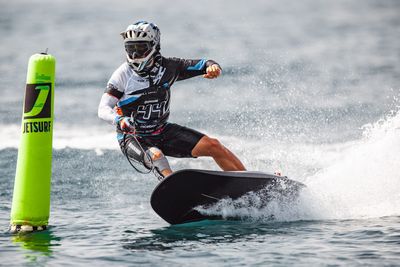
Photo: MotoSurf World Cup
-
Çeşme, Türkiye
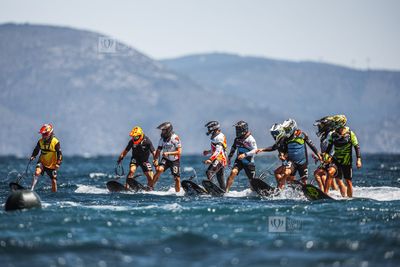
Photo: MotoSurf World Cup
-
Abu Dhabi, United Arab Emirates
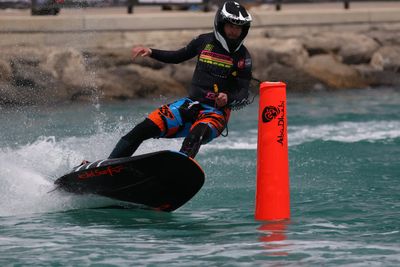
Photo: MotoSurf World Cup
-
Brno, Czech Republic
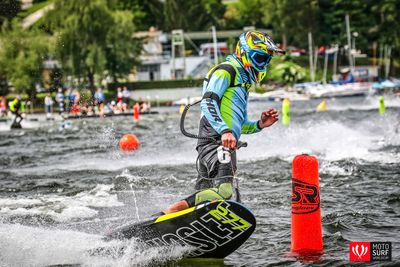
Photo: MotoSurf World Cup
-
Wyboston, Bedfordshire, United Kingdom
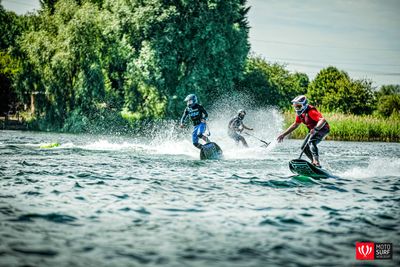
Photo: MotoSurf World Cup
-
Kazan, Russia
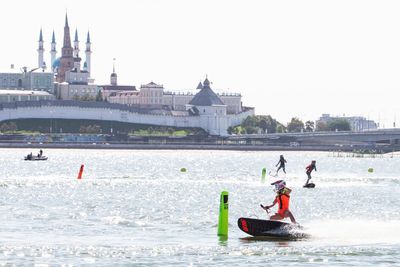
Photo: MotoSurf World Cup
-
Zadar, Croatia
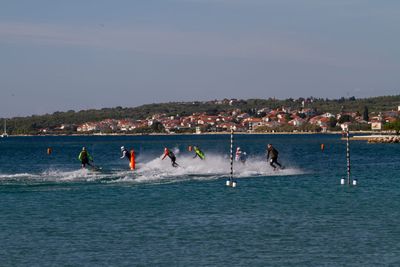
Photo: MotoSurf World Cup
-
Barrancabermeja, Santander, Colombia
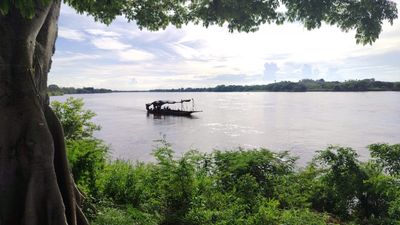
Photo: Valery Susej Parra, CC0 1.0
-
Keystone Heights, Florida
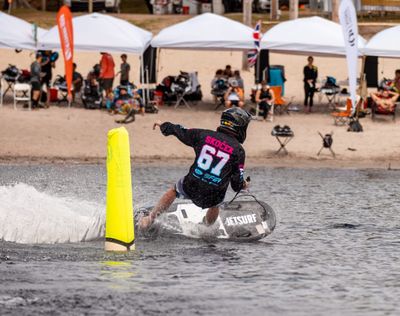
Photo: StarkeDCD, CC BY-SA 4.0
-
Colombo, Sri Lanka
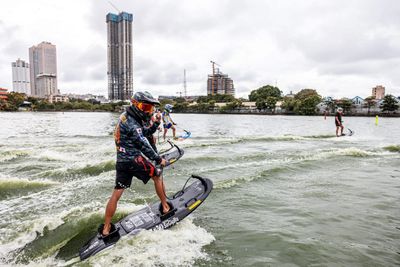
Photo: MotoSurf World Cup
-
Chengdu, China
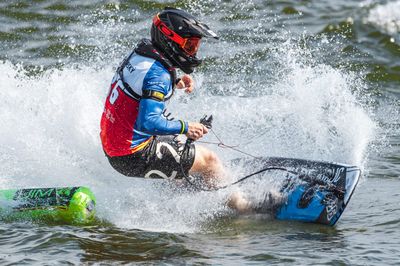
Photo: MotoSurf World Cup


9 of these photos are from the promoter's own site and 2 from Wikimedia Commons, each credited and linked on its card. Riders in them are not named. Used with the permission of MotoSurf World Cup, given for every picture on its site (the owner's record, 2026-11-01), credited and linked to the page it came from. It comes down at the promoter's request. Placed in the public domain by its author on Wikimedia Commons (CC0 1.0), credited all the same, shown resized and linked to its Commons page. Shared by its author on Wikimedia Commons under CC BY-SA 4.0. Changed here only by resizing and saving as JPEG; credited and linked to its Commons page.
The course
What a course is made of
- A course must have 25 to 40 buoys, balloons, and a finish gate or finish buoys in a checkerboard pattern. Art. 302
- It should also have left turns and right turns, each sharp, open or hairpin, a Long Lap and a Split Section. Art. 302
- It is always set up inside the zone marked out for the competition. Art. 302
- A buoy is inflatable or made of rubber, oval in shape, and anchored so that its line does not reach into the racing area. Art. 302.01
- Each buoy comes with a coloured sleeve. The colour of the buoy or of its sleeve tells the rider which way to pass it. Art. 302.01
Every rule on this page is from the 2026 MotoSurf Rulebook as corrected on 20 May 2026, unless a line says otherwise. Race Direction means the Officer of the Day (O.O.D.), the Sport Director, or both (Art. 307, 312.01); the O.O.D. chooses the start method and imposes penalties (Art. 313, 317).
- Y, a yellow buoy or sleeve: the course turns right round it, and it stays on the rider’s right (Art. 302.03 a)).
- R, a red buoy or sleeve: the course turns left round it, and it stays on the rider’s left (Art. 302.03 b)).
- Orange pair: the rider rides between the two where the course divides, then takes whichever route they like up to the merging point (Art. 302.04 a)).
- Merging point: drawn with no balloons, since the rulebook’s text and its picture caption disagree on how many close a split.
- End of the start section: a dotted mark only. The green balloons there are not drawn, because the side they are passed on is one of the open points listed further down.
- Finish gate: inflatable structures or two chequered buoys; every pass through it ends a lap (Art. 304).
- Starting blocks: used for a start from the shore (Art. 305).
- This one runs counter-clockwise; Art. 302 lets a course run either way. The Long Lap a course should also have is drawn on its own below.
A made-up course seen from above, with far fewer buoys than a real one. At a start from the shore, riders leave the blocks, run out through the start section onto the loop, and complete a lap each time they pass between the two chequered squares.
How we know: 2026 MotoSurf Rulebook, Art. 302 to 302.04, 304 and 305, drawn fresh from their words; which side of the rider each lettered buoy sits on is as the rulebook's pictures on pages 20 and 21 show it.
Not to scale.
Passing a yellow buoy on its right side or a red one on its left, or hitting either with the centre of the board, counts as a missed buoy (Art. 302.03 a), b)). The red paragraph’s second sentence names yellow, in the PDF as in the text copy; its first sentence and its picture caption name red, so it reads as a slip. Quoted as printed:
Correctly passed buoy marked with yellow sleeve means the buoy is passed from the right side.
Art. 302.03 b), the paragraph headed Red, page 21
Balloons and the Split Section
- A Split Section divides the course into two possible routes, and may be used as a place to overtake. It may be an alternating split, a parallel split or a Long Lap split. Art. 302
- Not passing the orange balloons counts as missing buoys, and is penalised by a Long Lap run or a time penalty. Art. 302.04 a)
- When two riders come back together from the two routes, the rulebook says there is "no given or preferred way by any rider". Art. 302.04 b)
- Every balloon has to be passed on the correct side. Any other passing is a missed balloon, with the same penalty as a missed buoy. Art. 302.04 b)
Which way round
- A course may be ridden clockwise or counter-clockwise. The direction is typically the opposite of the previous race, and Race Direction may change it if safety does not allow the course to be set the opposite way. Art. 302
- The direction is announced at the first riders’ briefing of the weekend and stays the same for every session of that event. Art. 311.02
- Riding the wrong way, turning round on the course, or going back for a missed buoy is forbidden, and can mean disqualification from the session. Art. 311.02
The finish gate and the starting blocks
- A lap is complete when a rider passes through the gate. On the last lap the chequered flag drops for the rider there. Art. 304
- If a board fails on the last lap within two buoys of the finish, the rider may swim with it to the finish. Anywhere else, the rider clears the way and waits for the end of the ride. Art. 304
- When boards cross the line together, the one whose front edge is closer to the finish line takes the better place. Art. 304
- A starting block holds the board in its starting position for a start from the shore. The rider sets the board on it, waits for the flag or light signal, and may stand on either side of the board. Art. 305
The rulebook recommends a starting block design in Appendix 1, Picture 3. It is not reproduced here.
- Y, yellow buoy
- A yellow buoy or sleeve marks a right-hand turn. The rider goes round its left side, which keeps the buoy on the rider's right hand. Art. 302.03 a), page 20
- R, red buoy
- A red buoy or sleeve marks a left-hand turn. The rider goes round its right side, which keeps the buoy on the rider's left hand. Art. 302.03 b), page 21
- O, orange balloons
- Orange balloons come in pairs. The rider goes between the pair that opens a split. Another pair marks where riders rejoin from the Long Lap zone, and the article does not say which side of that pair to pass. For the end of a split, the article's text asks for a pair while the picture captioned as the split exit shows three. Art. 302.04 a), page 21
- G, green balloons
- Green balloons show where the start section ends and the course proper begins. The article says they must be passed on the correct side, and gives neither that side nor how many there are, so the drawing shows one with no path past it. Art. 302.04 b), page 21
- Finish gate, chequered
- The finish gate is inflatable or a pair of chequered buoys. Timing runs from it, a lap ends at every pass through it, and jumping is banned for 10 metres all round it. Art. 304, page 23
- Every course is to have “25 to 40 buoys”. Art. 302
- For MotoSurf World Championship events only, a lap is meant to last 40 seconds or more, timed against the fastest rider in the Stock Men category. Art. 306
- Nowhere in Art. 302 to 308 does the rulebook say how far apart buoys are set, how big a buoy is, how long or how wide a course is in metres, or how big the start area is (the 2026 rulebook, read 18 October 2026). Art. 302.02 sends the reader to picture 1 for the official buoy, and Picture 1 in Appendix 1 shows a toothed side fin, crossed out.
The colours and the finish gate the 2026 rulebook defines, each drawn small with the line a rider takes past it where the rulebook gives one. The 5 rows follow the rulebook's own order.
How we know: 2026 MotoSurf Rulebook, Art. 302.03 a), 302.03 b), 302.04 a), 302.04 b), 304, pages 20 to 23, drawn fresh from the words. Turns are drawn as hairpins for clarity; a real course turns at whatever angle its layout gives, and Art. 302 allows sharp, open or hairpin. Which side of the rider a yellow or red buoy falls on is as its pictures on pages 20 and 21 show.
Not to scale.
What the course articles do not say:
- Which side of the green balloons is the correct one. Art. 302.04 says the balloons have to be passed on the correct side, and gives no side for the green ones (searched the 2026 text copy for "balloon" and "correct side" on 2026-10-07).
- What makes a split alternating, parallel or a Long Lap split. Art. 302 names the three kinds and describes none of them (searched the 2026 text copy for "split" on 2026-10-07).
- How many balloons close a split. The text says a pair of orange balloons marks the merging point, while the captions under the rulebook’s two small balloon pictures call the entry a two balloon section and the exit a three balloon section (Art. 302.04 a), page 21). Both are recorded here and neither is chosen.
- What the "previous race" in the direction rule refers to. Art. 302 does not say, and the phrase appears nowhere else in the rulebook (searched the 2026 text copy for "previous race" on 2026-10-07). Art. 311.02 is the article that holds one direction for a whole event.
A real course: Keystone Heights, 2023
MotoSurf Games 2023, which the article calls the first stop of the 2023 season, at Keystone Beach on Lake Geneva, Keystone Heights, Florida, April 2023. Course as published with WJCT News, 18 April 2023 (image credited MotoSurf).
The map shows 29 marks: 11 red, 7 yellow, 7 orange, 3 black and 1 open circle. In riding order:
- Where the dashed lines from START reach the course, round the first lobe: red, yellow, red, yellow, red.
- Back along the shore, between a pair: black, black.
- Over two humps toward the split: red, yellow, red, yellow, red.
- Where the course divides, one orange mark each side: orange, orange.
- The outer route: red, yellow, red.
- The inner route: yellow, red, yellow.
- Where the routes join, a row of three: orange, orange, orange.
- Back toward the first lobe, the orange standing between the line and the wide dashed loop: red, red, orange, open circle.
- Off the solid line: black, orange.
- Every red buoy sits inside a left-hand bend and every yellow one inside a right-hand bend, riding counter-clockwise: the same use the 2026 rulebook makes of them.
- Two orange marks stand where the course divides and three where the two routes meet, the numbers the 2026 rulebook's two balloon pictures show. One more orange mark stands beside each of two dashed lines.
- The black pair sits either side of the line along the shore. The third black buoy is at the far end of the widest dashed loop, and the open circle, which the map draws with no fill, is where that loop meets the course nearer the first lobe.
- Dashed lines: two run from the ends of the START box to the high point of the first lobe, one cuts across that lobe, and one swings wide round the far black buoy.
The 2026 rulebook gives no meaning to a black buoy or an open circle, and the 2023 event may have run under different rules, so this page gives those buoys no meaning.
The 2023 Keystone Heights layout, redrawn from its published map and turned a quarter turn so the shore runs down the left. Buoy places are only approximate, because the map gives no distance, scale or lap length.
How we know: The map published with WJCT News on 18 April 2023, credited MotoSurf; every colour, count and the direction were read off it. Colours are lettered, not printed; the one circle the map leaves unfilled is drawn empty.
Not to scale.
The long lap
A Long Lap is an alternate, longer section of the course, longer in distance, in time, or both. Its zone is marked by one or more clearly distinguishable buoys, and the first of them must be easy to identify (Art. 302).
- Going into the Long Lap twice in one lap counts as one. Art. 302, 317.01
- A rider going into the Long Lap shows it by raising an arm. Art. 317.01
- The time penalty for not riding a Long Lap is announced by the O.O.D. before the heats, and is given for each breach. Art. 317.01
- Race Direction can change the number of Long Laps before or during an event. The note under the lap chart sets out on what grounds. Art. 307
- How many: the lap chart sets the number for each class's heats and Final, 2 or 3 in the 2026 chart below, and Race Direction may change it (Art. 307).
- When: from the second lap on, once the rider has been through the finish gate (Art. 302, 317.01).
- How often: one per lap at most, on laps the rider picks (Art. 302, 318.05).
- The way back: a pair of orange balloons marks it (Art. 302.04 a)), drawn here as a plain mark because the side to pass them is not given.
Some laps go the long way round. The Long Lap is a longer branch each rider has to ride a set number of times in a heat or Final, never on the opening lap and counted at most once in any lap.
How we know: 2026 MotoSurf Rulebook, Art. 302, 302.04 a), 307, 317.01 and 318.05, in the corrected edition of 20 May 2026; neither line struck through on its page 19 is drawn.
Not to scale.
Two lines the correction struck out
The corrected edition of 20 May 2026 strikes two Long Lap lines on page 19: a passage time of 20% to 50% of the average Stock Men lap, and a Long Lap making up for a missed buoy. The text copy loses the strike, so both were read from the PDF on 7 October 2026. This page uses neither.
On a missed buoy, the rulebook still says 5 things in different articles, and does not say how they fit together. All of them are recorded here, and none is chosen:
- A 15 second time penalty for each buoy missed in a session, and a further time penalty, decided by the O.O.D., if missing it gave the rider a significant advantage. Art. 317.03
- A buoy missed because of an obstacle in the water, for safety, or because another rider forced the rider off the course may not draw the standard penalty. The obstacle must be there at that moment, the rider must rejoin without gaining time or places, and the O.O.D. decides from the official camera footage. Art. 317.04
- A rider who misses a buoy rides an extra Long Lap in that lap or the next, and it does not count as one of the required ones. Art. 318.05
- For the orange balloons, a Long Lap run or a time penalty. Art. 302.04 a)
- Missing more than three buoys in one lap disqualifies the rider from the session. A rider who falls in may miss one buoy, or two in a slalom section, without it counting. No article defines a slalom section (searched the 2026 text copy for "slalom" on 2026-10-07). Art. 317.05
How many laps the rulebook sets: the lap chart
Laps are set per group of classes, printed here exactly as the rulebook groups them.
| Grouping, as printed | Heats | Final | Covers | Change since 2025 |
|---|---|---|---|---|
| Elite Men | 8 laps, 3 long | F1: 10 laps, 3 long | Elite Men | was the ELITE line; heat long laps 2 to 3; final laps 12 to 10; final long laps 2 to 3 |
| Stock Men / Masters Men | 7 laps, 3 long | F1: 10 laps, 3 long | Stock Men, Masters Men | was the Stock / Stock R / Masters line; heat laps 6 to 7; heat long laps 2 to 3; final long laps 2 to 3 |
| Elite Women / Masters Women | 7 laps, 3 long | F1: 9 laps, 3 long | Elite Women, Masters Women | was the Women line; now also covers Masters Women; heat long laps 2 to 3; final long laps 2 to 3 |
| Juniors Boys / Juniors Girls | 5 laps, 2 long | F1: 6 laps, 2 long | Juniors Boys, Juniors Girls | was the Juniors line; heat laps 4 to 5; heat long laps 1 to 2; final long laps 1 to 2 |
| Electric Challenge | 5 laps, 2 long | F1: 6 laps, 2 long | Electric Challenge | finals F1, F2 to F1 |
Article 307.
| Grouping, as printed | Heats | Final | Covers |
|---|---|---|---|
| ELITE | 8 laps, 2 long | F1: 12 laps, 2 long | Elite Men |
| Stock / Stock R / Masters | 6 laps, 2 long | F1: 10 laps, 2 long | Stock Men, Masters Men |
| Women | 7 laps, 2 long | F1: 9 laps, 2 long | Elite Women |
| Juniors | 4 laps, 1 long | F1: 6 laps, 1 long | Juniors Boys, Juniors Girls |
| Electric Challenge | 5 laps, 2 long | F1, F2: 6 laps, 2 long | Electric Challenge |
Article 12.6. Its Stock / Stock R / Masters line names Stock R, a class the 2026 body does not define.
The weekend in order
Order only, no days or clock times. Art. 321 runs an event over four days, one of technical controls and three race days, and has the exact schedule published before each race; its example timetable may change.
- 1
Registration and inspection
Art. 206.01, 500, 318.04
- 2
Briefings
More than one, through the weekend (Art. 317.07, 311.02, 312.01, 313).
- 3
Free practice
Ahead of warm up and qualifying by article number only (Art. 318.01).
- 4
Warm up and qualifying
Both come before the heats, in an order no article sets, and no article places the warm up against the drawing of the groups (Art. 318.02; 318.03.01 to 318.03.03; 318.04 and 318.05).
- 5
Groups for the heats
Set from the qualifying results; at a World Championship round a class runs a capped number of groups, so only its top qualifiers go on (Art. 318.04, 322.01).
- 6
Heats 1 to 4
One practice start comes first, at some point before Heat 1 that no article fixes (Art. 314, 318.05).
- 7
The Final
Art. 318.06
- 8
The podium
Art. 319, 320
Whether it counts. Art. 321.06 wants at least one free practice and the qualifying run before championship points are given, and also says that if only qualifying can be finished, its results name the winners and no championship points are given.
The weekend as one chain of sessions from arrival to the podium. Box 4 holds both warm up and qualifying, items 4 and 5 of the list below, because the articles leave their order open; every later box is one number behind its list item.
How we know: 2026 MotoSurf Rulebook, the articles named in each box; order only, since Art. 321 lets every timetable change.
- Registration and technical inspection. Registration covers technical inspection of the board, inspection of safety equipment, the licence, the entry fee and handing out the race schedule. Late registration is refused, though a rider may ask once a season for extra time to arrive and register, except at their first race.Art. 206.01 Each item that passes inspection gets a sticker, and a rider without the sticker is not admitted to the race.Art. 500 Groups are based on the number of riders registered on registration day. No entries are taken after registration closes.Art. 318.04
- Briefings. Every briefing is compulsory for riders still racing that weekend. One absence or late arrival is a 100 EUR fine, and two or more mean disqualification from the event.Art. 317.07 The riding direction, the start method and the flying start formation are all announced at briefings.Art. 311.02, 312.01, 313
- Free practice. Riders practise in groups set by championship standings where there are any; for the first race, the previous season’s may be used. A rider who misses their slot may join another group only with Race Direction’s prior agreement.Art. 318.01 Practice opens on the green flag and ends on the chequered flag. Practice starts from the starting block are forbidden and penalised.Art. 318.01 Order by article number only (read on PDF pages 33 and 34, 2026-10-07).Art. 318.01 to 318.03
- Warm up. A warm up session comes before the heats, for riders to warm up, look over the course and warm up their boards. Groups follow the free practice rule, and starts from the block are again forbidden. The articles place it before the heats and do not say whether it comes before or after qualifying.Art. 318.02
- Qualifying. Qualifying is compulsory. Riders go out in pairs or in trios, set by championship standings where there are any, and each rides two timed laps in the announced direction. One more lap may be granted after an obstruction, up to three, unless the O.O.D. allows more. The rulebook sets out both pairs and trios and does not say who chooses between them (searched the 2026 text copy for "pairs" and "trio" on 2026-10-07).Art. 318.03.01 to 318.03.03 The fastest lap takes pole position: that rider leads a flying start, or picks the first block for a start from the shore. Ties go to the second best lap, then to drawing lots. A rider with no time starts from the back.Art. 318.03.01
- Groups for the heats. Qualifying results set the groups. The qualifying winner leads Group A, second place leads Group B, and so on.Art. 318.04 Tables on page 36 of the rulebook show how riders from two, three or four groups are spread across the four heats. They are pictures, absent from the text copy, and this page does not reproduce them.Art. 318.05 At a World Championship round each class may run only a set number of groups, and the qualifying decides who fills them. In the article’s own example, with 30 Elite Men entered and one group allowed, only the top 12 go on to the heats.Art. 322.01
- Heats 1 to 4. Heat 1 is preceded by one practice start, to rehearse the start the races will use (read on PDF page 30, 2026-10-07).Art. 314 Heats run in the same direction as qualifying, over the laps in the lap chart. The full format is four heats, and each rider’s best three count.Art. 318.05 Only a rider who passes through the gate and takes the chequered flag scores. Once the first rider takes it, every rider is flagged, and lapped riders do not ride their missing laps.Art. 318.05
- The Final. One Final, called F1, in the same direction as qualifying, over the laps in the lap chart. The winner of the heats leads the start. A rider who does not finish scores nothing.Art. 318.06
- The podium. Every race ends with a podium ceremony for the top three in each class, placed in the order of the Final.Art. 319, 320
When an event counts
- To be valid and award championship points, an event must run at least one free practice and the qualifying. The minimum for heats, and for Finals, is zero. Art. 321.06
- Yet if conditions allow only the qualifying to be completed, the race winners are declared from its results and no championship points are awarded. The article does not say how its two parts fit together. Art. 321.06
- The O.O.D. may change the format for the weather or other conditions. Points are then given only for sessions actually run, and are never multiplied to cover missing ones. Art. 321.05, 321.07
- If fewer than three heats are run, every heat counts and none is dropped. Art. 321.07
The rulebook’s example timetable
Art. 321 prints an example timetable for each of the four days, on pages 38 to 41. They are pictures, so the text copy holds only their headings, and they were read from the PDF pages on 7 October 2026. This page takes its order from the articles instead, because the timetable does not match them:
| The timetable, PDF pages 38 to 41 | The articles |
|---|---|
| Classes include Stock R and Women | No Stock R class is defined; Women is now Elite Women (Art. 301.02) |
| “Jokers”, the 2024 edition’s word | Long Laps (Art. 302) |
| Elite final: 12 laps, 2 jokers | 10 laps, 3 Long Laps (Art. 307) |
| No warm up session | A warm up before the heats (Art. 318.02) |
Points per place in heats and the Final
The two tables print the same figures, as Art. 319.02 says they should.
A heat and the Final pay out alike, place for place, so this one chart stands for both tables. The tables list points for the first 12 places.
How we know: 2026 MotoSurf Rulebook, the points tables of Art. 319.01 and 319.02, both on page 37 of the corrected PDF.
Art. 319.01, Table 2, and 319.02, Table 1, read from page 37 of the corrected PDF on 7 October 2026, because the text copy scrambles the heats table.
- A rider’s weekend total is the points from their best three heats plus the Final. That total is what goes into the championship. Art. 319.04
- A rider disqualified from a heat scores zero for it, and that zero cannot be the heat that is dropped. Art. 319.01
- A rider who does not receive the chequered flag is classed DNF, did not finish, and scores zero wherever they are on the course. Art. 319.01
- Riders level on points after the best three of four are separated by their qualifying result. Art. 319.01
- The top twelve overall take their places from the Final. Every other rider is placed by the ranking from the heats. Art. 319.03
- Season standings add up every race weekend’s total. Riders level on points are separated by their places at the last valid race weekend. Art. 319.04
Starts
There are two ways to start a race: a flying start, also called a rolling start, and a start from the shore, also called a standing start (Art. 312). The O.O.D. chooses one, taking account of the conditions at the venue with rider safety first, and announces it at the riders’ briefing (Art. 313). Neither article names one as the usual start (searched the 2026 text copy for "standing start", "rolling start", "usual" and "default" on 2026-10-07). A practice start comes once, before Heat 1 (Art. 314).
A start from the shore
- Each rider lines up beside a starting block. For Heats 1 to 3 riders choose blocks in qualifying order; for the Final, in order of the sum of Heats 1 to 4. The higher placed rider picks first. Art. 312.02.02
- Helpers may carry boards to the start, but once the start procedure begins every rider is on their own. Art. 312.02.03
- The Pits Area Coordinator raises a flag and blows a whistle. A horizontal flag tells riders to get ready and start their engines. When every rider is ready, the coordinator raises the green flag as the signal to the Start Marshal. Art. 312.02.04
- A rider with a problem raises a hand. The start waits 2 minutes, then 2 more, and then goes ahead. A rider who can change boards may use another that passed technical inspection for that class. Art. 312.02.04
- In a flag start, the Start Marshal starts the session with a rapid downward movement of the flag. Once that flag is up the procedure is not interrupted, and it is never interrupted a second time. Art. 312.02.05
- After a start from the shore, a rider must be standing before the first turn buoy, and after a fall must be standing again within two buoys. Missing either costs a 10 second penalty. Art. 311.01, 317.06
Starting lights
- A starting lights start runs like a flag start, with a light of three lamps in place of the green flag. Art. 312.02.06
- The light may be mounted on a structure, on the shore or on a jet ski. Art. 312.02.06
- The Guards Officer raises a green flag to tell the O.O.D. the riders are ready. A whistle and a flashing light then tell riders to start their engines. Art. 312.02.06
- As at a flag start, a rider with a problem raises a hand. The Guards Officer signals the delay to Race Direction with a red flag, and the rider has two minutes to start the board. If it starts, the Guards Officer shows a green flag; if not, the O.O.D. resumes the start. Art. 312.02.06
- No rider may go before all three lamps go out. Art. 312.02.06
- Once the lamps are lit, the start is not held for a rider’s problem, and it is never held a second time. Art. 312.02.06
The lights start a race by going dark. They build up from the left, hold for a pause no rider can predict, then all go out at once, and that moment is the start.
How we know: 2026 MotoSurf Rulebook, Art. 312.02.06, which gives the lamps' number, order and timing but no colour, so lit and dark are shown by shape.
Not to scale.
A flying start
- Riders line up in the starting area in a set formation and ride toward the start line, starting on the Start Marshal’s signal. Art. 312.01
- The O.O.D. announces the formation at the briefing before the heats. It is either a V shape or a cascaded single line. Art. 312.01
- In both, the leading rider is always on the inside of the first turn. If the first turn is to the right, the formation is mirrored. Art. 312.01
- Each board’s nose follows the tail of the board ahead without overlapping it, no more than two board lengths behind along the course, and at least an arm’s length to the side. Art. 312.01
- The second row begins with rider 7, at least half a board length behind rider 6. If rider 7 follows in line with riders 1 to 6, that rider counts as part of the first row and takes a jump start penalty. Art. 312.01
- A rider who slows on purpose, or leaves more than two board lengths to the rider ahead, starts last at the next start. Art. 312.01
- The leading rider sets a steady pace, neither too slow nor too fast. A leader who changes speed or riding style a second time is moved to the back of the group. Art. 312.01
- A jump start costs 100% of the announced lap time, judged from camera footage. Art. 317.02
The two formations are described in words. The rulebook’s own layout of riders 1 to 12 is not reproduced.
Restarts
- After an interruption the O.O.D. may order a restart, from the same starting positions as before. Art. 315
- A heat stopped after 4 completed laps, or a race after 6, is not restarted: the last completed lap stands. Art. 316
What the start articles do not settle:
- The colour of the starting lights. Art. 312.02.06 gives their number, their order and their timing, and no colour (searched the 2026 text copy for "light" on 2026-10-07).
- The block order for Heat 4. Art. 312.02.02 orders Heats 1 to 3 by qualifying and the Final by the heats, and says nothing of Heat 4.
- Where rider 7 goes in a cascaded line. The second row rule in Art. 312.01 penalises a rider 7 in line with riders 1 to 6, and the rulebook’s own cascaded layout on page 28 puts rider 7 in exactly that line. Recorded, not settled, and no picture should be drawn from it.
- When a stopped heat is repeated. Art. 316 says a heat with 4 laps completed is not restarted. Art. 308.06 sets other thresholds when the course is declared improper: three quarters of the laps for a sunk buoy or lost sleeves, half for a moved buoy or gate, or the heat is repeated. The rulebook does not say how the two fit.
- The starting order for the Final. Art. 319.01 says the heat ranking, built on the best three of four heats, sets the starting positions for the Final. Art. 312.02.02 has riders choose their blocks for the Final by the sum of Heats 1 to 4. The two can differ when a dropped heat matters, and the rulebook does not say which applies.
Signals on the water
Riders must watch for every flag signal on the course, and ignoring one can be penalised as irresponsible riding (Art. 206.01). The Flag Marshal also shows the number of laps left, counting down, based on the leading rider (Art. 310).
Several signals below send riders off the course. Leaving the course safely means carrying on in the direction of travel, outside the line of buoys, to the exit area. A rider never turns back or crosses the course to leave (Art. 303.03).
The 5 flags
- Starting: ready, steady, go. Waved, the course is clear and riders may carry on. It also opens the way into the water. Art. 309.01.01
- The session stops at once; leave the course safely, for the shore. Raised, nobody goes into the water. Rescue and emergency services are called out at once. At a lights start, the Guards Officer also uses it to tell Race Direction the start is delayed. Art. 309.01.02, 303.05 d), 312.02.06
- One rider’s ride is over: that rider leaves at once by the safe path, for the shore. Art. 309.01.03
- Waved, the session is over. A leader about to lap someone is flagged first. Art. 309.01.04
- Last lap of the heat or race. Art. 309.01.05
A quick key to the flags on the water: each drawn alike, told apart only by the colour written inside it, with the gist beside it and the full wording in the list that follows.
How we know: 2026 MotoSurf Rulebook, Art. 309.01.01 to 309.01.05, with Art. 303.05 d) and 312.02.06 for the red flag.
- Green flag
- Used for starting. Held out sideways, level with the water, it means ready; held upright, steady; moved downward, go. Waved, it tells riders the course is clear of obstacles and they may carry on, and it tells the Start Marshal the riders are ready. It also opens the entry to the water, and is always used to reopen an entry the red flag has closed. Art. 309.01.01
- Red flag
- Stops the session at once. Riders head off and leave the course for the shore by the safe exit described above. Raised, it also closes the entry to the water, and no rider may go in. A red flag means rescue and emergency services are activated at once; the Track Referee waves it above the head on seeing an injured rider. At a starting lights start, the Guards Officer’s red flag tells Race Direction the start is delayed for a rider. Art. 309.01.02, 303.05 d), 312.02.06
- Black flag
- Ends one rider’s ride at once. That rider leaves the course at once by the safe path and heads for the shore. Art. 309.01.03
- Chequered flag
- Waved, it ends the session. When the leader is lapping another rider, the leader has priority for the flag, and the lapped rider need not be shown the last lap flag. Art. 309.01.04
- White flag
- The last lap of the heat or the race. Art. 309.01.05
The O.O.D. may also wave the red flag to stop a session on a course declared improper (Art. 308.07).
When a hand goes up
The first 4 rows are the signals for injury and breakdown.
| When | What the rider does | Art. |
|---|---|---|
| Injured, and able to signal | Raise one hand from the water and lift the nose of the board while lying on it. | 303.05 a) |
| Seeing an injured rider who cannot signal | Raise one hand at once and ride toward the injured rider. | 303.05 b) |
| Seeing an injured rider, or the raised hand of a rider going to help | Raise a hand and leave the race course safely. | 303.05 c) |
| A technical problem that needs the race stopped | Raise a hand as for an injury, and rotate it above the head. | 303.06 |
| At a start, with a problem | Raise a hand. The start may be held, but not once the Start Marshal’s flag is up or the lamps are lit, and never twice. | 312.02.04 to 312.02.06 |
| In qualifying, after a fall or choosing not to carry on with the lap | Raise one hand. | 318.03.02 |
| After the practice start, as the leading rider | A raised hand means slow down and follow me. | 314 |
| Claiming the course is improper, for example after a buoy has sunk | In the finish area, move the free hand up and down below the waist, repeatedly and visibly, while slowing down. | 308.07 |
| Going into the Long Lap | Raise an arm. | 317.01 |
Any injured rider must have a medical examination (Art. 303.05). After an injury or a serious technical problem the rider sees a doctor or a mechanic, and stopping a session without good reason is penalised as unsportsmanlike behaviour (Art. 303.06). Whether an injured rider may race on is the doctor’s decision alone, delivered to the O.O.D. at least 30 minutes before the session (Art. 303.07).
Money: entry fees, penalties, deposits and expenses
4 published entry fees, all from the older edition. 2 entries that name no figure at all. Everything else here is a penalty, a deposit or an expense, and the table says which, because a deposit for appealing a decision is not a cost of going racing.
Apart from the provisional 2027 list near the top of this page, this site holds no calendar of coming events. Where a fee names no figure, the figure is in the event's Advance Programme, which the 2026 rulebook has the promoter publish at least 60 days before the event (article 203). Article 201 says the entry fee is specified in that programme and that the preliminary program and registration are available on the organiser's website. The rulebook gives no address for it.
| What | Amount | Who pays whom | Edition and article |
|---|---|---|---|
| Race entry, every class This single sentence replaced the four published figures above. The rulebook no longer tells a rider what entering costs. | Race entry fee shall be defined in each Advance Programme before every event. | rider to event organiser | 2026, Art. 204 |
| Race entry, Elite, Stock and Masters | 150 EUR | rider to event organiser | 2025, Art. 10.1 |
| Race entry, Women | 120 EUR | rider to event organiser | 2025, Art. 10.1 |
| Race entry, Juniors | 60 EUR | rider to event organiser | 2025, Art. 10.1 |
| Race entry, Electric Challenge | 60 EUR | rider to event organiser | 2025, Art. 10.1 |
| Race entry, Continental Championship Worth noting because it is the shape the 2026 edition later applied to every class: the delegation existed for the continental series a year before it replaced the world championship schedule. | Defined in each Advance Programme rather than in the rulebook. | rider to event organiser | 2025, Art. 10.2 |
| What | Amount | Who pays whom | Edition and article |
|---|---|---|---|
| Absence from, or late arrival at, the riders' briefing One absence or late arrival. The rulebook states the figure per offence. | 100 EUR | rider; payee not stated | 2026, Art. 317.07 |
| Leaving parc ferme early Riders must remain in parc ferme for six minutes after a session. The figure appears twice in the article, once for each of the two parc ferme regimes it describes. | 20 EUR | rider; payee not stated | 2026, Art. 508 |
| What | Amount | Who pays whom | Edition and article |
|---|---|---|---|
| Protest deposit Fixed, and must be handed over with the protest at the time it is lodged. | 150 EUR | protesting party; payee not stated | 2026, Art. 403.02 |
| Appeal deposit Art. 405.10 sets two tiers of the same deposit. The second payment in each tier covers the costs of the appeal procedure. If the appellant asks for the appeal to be heard with the parties physically present, costs above the deposit fall on the appellant too, so each figure is a floor rather than a price. | 2000 EUR for a titled international series, 1000 EUR for a single event championship, and in each case the same figure again to the sanctioning body. | rider to appeal body, and separately the UIM | 2026, Art. 405.10 |
| What | Amount | Who pays whom | Edition and article |
|---|---|---|---|
| Commissioner daily allowance Included because it is the only figure in the 2026 edition that is not a penalty or a deposit, and because it runs in the opposite direction to everything else here. The organiser also owes a return economy air fare from the commissioner's place of residence. | 60 EUR Minimum, where meals and local transport are not provided. | event organiser to UIM Commissioner | 2026, Art. 110.05 |
What the rulebook does not price
- Refuelling. The 2025 edition has riders prepay for the organiser's fuel at registration and leaves the price per weekend to the Advance Programme (2025 Art. 9.6 b), so there is no figure to publish. The 2026 edition sets no fuel price and no fuel rule, beyond a bare heading among its event services (Art. 800) and a penalty at Art. 207.02 for breaching equal fuel supply.
- A licence. An International licence from the rider's National Authority is compulsory to enter, and neither edition states what one costs: the 2026 edition leaves the yearly cost to the National Authority (Art. 202.04).
- Environmental fines in euro. The UIM Environmental Code bound into the 2026 rulebook sets its fines in US dollars, and mostly as ceilings rather than prices. The driver responsible can be fined up to USD 1000 for servicing without an environmental mat (Code 7 c)), up to USD 500 for emptying waste fluids onto the ground or into the water (Code 7 e)) and up to USD 500 for breaching the cleaning area rule (Code 8 c)). An organiser that breaks the Code's Article 11 faces a fine of at least USD 1000. Codes 7 c) and 8 c) and Article 11 each allow a different amount where a discipline's own rules set one, and the MotoSurf rules hold their environmental section open for future use (Art. 700). The 2025 edition prints the same figures. They are kept out of the tables above, which hold the MotoSurf rules' own euro figures, and the kit and consumables page covers the mat itself.
- Anything a rider actually spends: no board price, no travel, no entry to a continental round and no cost of the mandatory safety equipment.
Every figure names its edition and article; the two editions number differently, so their citations never mix. Where the text copy loses a table, a picture or a struck line, the section names the PDF page read instead.